TOOL & FIXTURE MANUFACTURING

Clamping Devices
/ Holding Fixtures

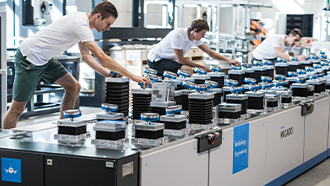
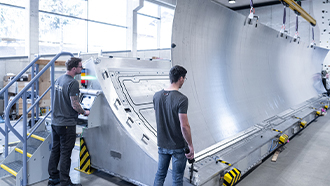
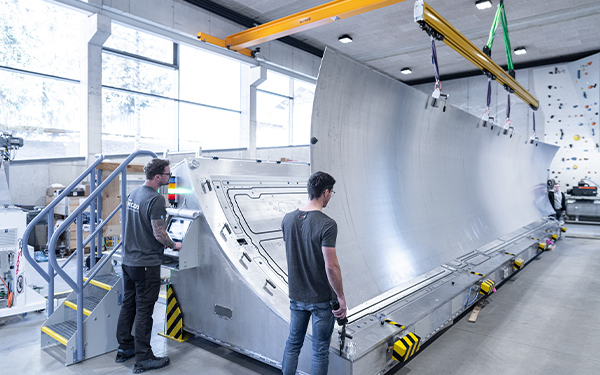
After the molding process, clamping devices / holding fixtures are an essential component of automated milling using a CNC machine. The fixture conforms to the component geometry and usually holds the workpiece using vacuum.
OUR PORTFOLIO

Three ways to the perfect fixture

From custom-made hard tools to freely configurable universal clamping fixtures
01
Tolerances up to ±0.05 mm in series production
Composite and Special Machine Construction
Direct application with OEMs (Airbus, Boeing)
From prototype to production readiness
02
Robotics & Manufacturing System Integration
Average project duration: 12 months
CE-compliant commissioning from a single source
Feasibility study to series production
03
Design for manufacturability from day 1
25+ years of composite experience
Fewer iterations, faster approvals
Risk-minimized industrial implementation
DECISION AID

Comparison
conventional vs. universal

We deliver to regulated and unregulated industries — the methodology remains the same: traceable design, validated manufacturing, documented handover.


No. 01

Component Positioning

Precise positioning of components on the fixture is extremely important for machining quality. Usually, features are present on the component (holes, recesses, precise stops...) which then find their counterpart on the fixture.

  • CONVENTIONAL
    — Simple positioning
    — Positioning element is an integral part of the fixture
    — High repeatability

  • UNIVERSAL
    + Positioning is a particular challenge
    + Suction cup positions are only of limited use as they are at fixed grid points
    + Auxiliary elements such as adjustable adapters or tools are necessary
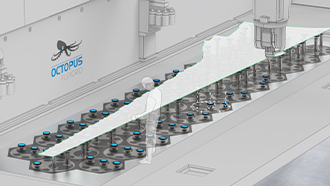
    + Exception: MICADO OCTOPUS with individual positions
N°02

Milling Quality

Milling quality is influenced by many factors. Primarily, the machine, milling tool, and cutting parameters used are decisive. Nevertheless, the clamping fixture also has a significant influence.

  • CONVENTIONAL
    — Highest machining speeds possible
    — Large-area clamping prevents vibration & deformation
    — Clamping surface required close to the milling edge
    — Even overhang must be clamped

  • UNIVERSAL
    + Fixture is highly process-critical
    + Few clamping points / small contact surface
    + Risk of deformation & vibration
    + Springback during drilling and vibrations can cause chatter marks or delaminations
    + Close coordination of fixture & milling parameters is necessary for a good and stable process
N°03

Net Milling Times / Production Rate

Net milling times refer to the periods during a complete post-processing operation for fiber composite components when the milling machine is actively cutting. It is important to note that, especially in the aerospace industry, production often operates with a batch size of 1. This means that two identical parts are never milled consecutively; instead, the process is always thought of in terms of shipsets. A shipset includes all components required later for the assembly of a sub-assembly.

  • CONVENTIONAL
    — Reduced net milling times due to frequent retooling
    — Two work areas within the milling machine reduce downtime
    — Alternatively, pallet systems can be employed for external setup

  • UNIVERSAL
    + No fixture change required - only automatic “reconfiguration”
    + Configuration time: a few seconds up to approx. 20 minutes (concept-dependent)
    + No handling of heavy fixtures required
    + No storage space consumed
N°04

Production Risk

High fixture availability is a prerequisite for reliable production planning. This heavily depends on the complexity and quality of the execution.

  • CONVENTIONAL
    — Low risk of production downtime due to individual fixtures for each component
    — Repair and maintenance often possible in-house
    — High repeatability

  • UNIVERSAL
    + Failure risk depends on complexity & quality
    + Many servomotors = high risk
    + Passive systems are significantly more reliable
    + Stocking spare parts highly recommended
    + Rapid response required in case of downtime
N°05

Costs

Costs are divided into investment and operating costs. Only by considering them over a specific lifespan can a valid comparison be made.

  • CONVENTIONAL
    — Higher acquisition costs per component
    — Additional costs due to storage
    — Manipulation and handling increase effort

  • UNIVERSAL
    + Generally lower acquisition costs per component, especially for large parts
    + Low storage costs
    + Significantly accelerated process

Conclusion

Conventional fixtures are indispensable when the machining process requires almost full-surface clamping and/or the geometries to be clamped are very complex.

However, if this is not the case, universal fixtures can offer significant advantages and considerably strengthen the competitiveness of the manufacturing company!
IN USE at
Tier 1 suppliers and OEMs
“Every company has unique requirements and processes. Together with your specialists, we will find the perfect solution.”

Ing. Markus Rath

Head of Mould Tools & Jigs
Contact us now ->